

What is DPI?
Firstly, DPI(Digital Public Infrastructure) has an infrastructure capability, meaning it performs a foundational and common role across public and private sectors. Organically, this means DPI needs to be interoperable (i.e. communicate with multiple, diverse modules of technical architecture).
Secondly, DPI serves a public interest – specifically prioritizing access and inclusion – and thus has a governance structure that supports the public interest. Secondly, DPI serves a public interest – specifically prioritizing access and inclusion – and thus has a governance
The global DPI map
The DPI Map offers a global view of the state of DPI. It effectively maps how the national or regional deployment of digital identity, digital payment and data exchange systems (treated as foundational components of DPI) embody technical and non-technical characteristics of DPI.
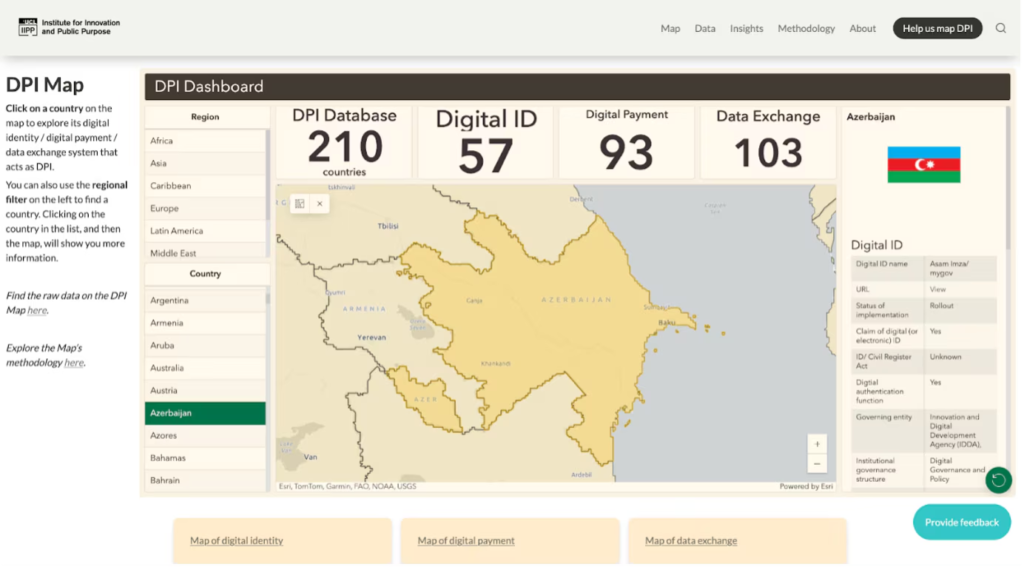
We’ve gathered meaningful insights on how these infrastructure pieces look on the ground, and where there are gaps in the collective intelligence. For one, we know that around the world more than we initially thought. As many as 100 countries have systems to exchange data and information in an interoperable way. Half as many have an identity system that does so.
What are the characteristics of the digital public infrastructure
- Maximize public value creation: The digital systems comprising DPI are governed, first and foremost, with the public interest in mind. Rather than enabling the consolidation of digital services and resultant data to a few actors, DPI prioritizes equitable access, population-scale inclusion, and encourages competitive markets.
- Prioritize the rights and aspirations of all people. The digital systems comprising DPI are architected to minimize personal data collection, and, importantly, to give people agency over how their data is used and the means to benefit from participation in the data economy. This implies ensuring meaningful consent and effective redressal mechanisms are “baked in” to the technology design and enabling policy environment.
Who builds and maintains the layers of digital public infrastructure?
Any government agency, private sector company, or foundation may develop the foundational layers for DPI, but typically we find a mix of organizations working in partnership to do so. Sometimes these efforts are government-led, as in the case of India and Estonia. In others, it might be led by private sector organizations. Moreover, it’s not unusual to find different agencies or companies “owning” different layers of their country’s DPI.
Sustainability systems in the DPI landscape
Credible sustainability systems are well-positioned to contribute to the development of DPI. The ecosystem approach’s emphasis on collaborative frameworks is compatible with their knowledge of multi-stakeholder governance. The ISEAL primer specifically notes how such cooperation can address fragmentation in sustainability data: a challenge particularly evident in origin traceability requirements for regulations like EUDR. “DPI offers a transformative approach to sustainability challenges—enabling businesses to move from fragmented compliance efforts to collaborative, data-driven solutions,” said Patrick Mallet, ISEAL Director, Credibility and Innovations. “The ISEAL Primer underscores how DPI can address critical gaps in supply chain transparency, particularly for regulations like EUDR.
Implementation pathways
For sustainability systems to participate actively in DPI, there are several practical considerations:
- Alignment with existing frameworks,
- Gradual integration
- Collaboration across industries
Building upon existing systems rather than developing entirely new ones is recommended by the ISEAL primer. In accordance with the primer’s recommendation for phased implementation, integrations between certification systems and national DPI components could be tested in early-stage pilots. Mapping DPI capabilities to particular certification standards or legal requirements may be one way to do this. The success of ecosystem development depends on cooperation between companies, standards organizations, and technology suppliers.
New opportunities
DPI builds on the concept of an ecosystem approach, where stakeholders come together to map, share and use data effectively, across organisations and systems. DPI is the foundation upon which data can flow and generate value more easily. In today’s data-driven world, when businesses and individuals depend on data to innovate, make decisions, and solve complicated problems, this approach is becoming more and more crucial. The continual development of DPI efforts can assist businesses and sustainability systems by improving compliance efficiency and sustainability effect, especially when conducted through collaborative frameworks that consider the needs of all stakeholders.