
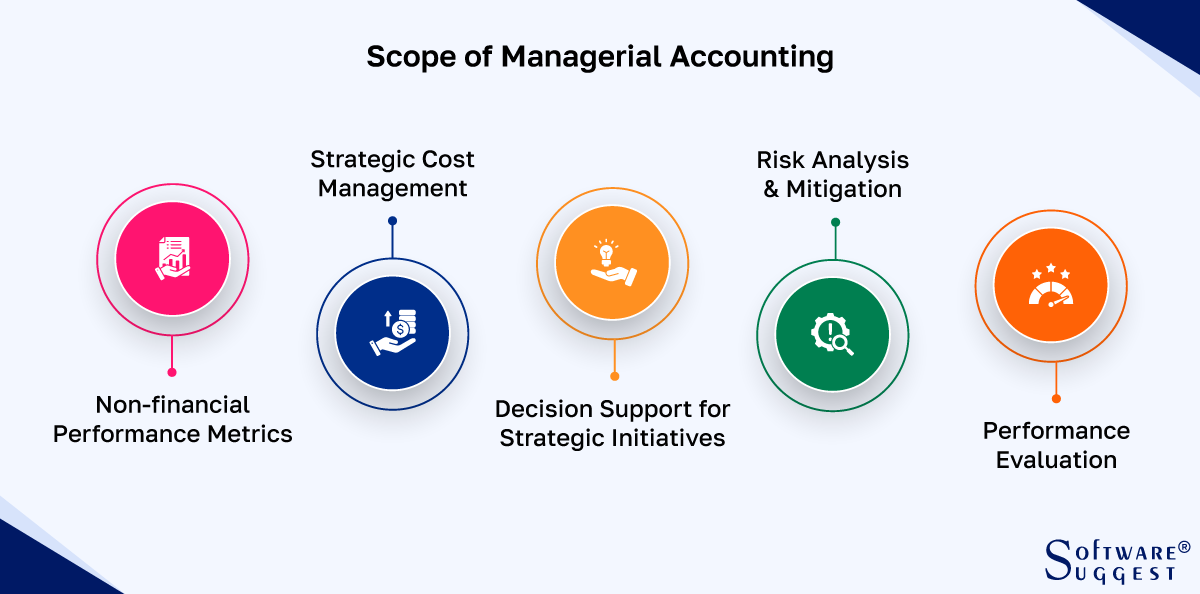
What is Managerial Accounting?
The main goal of management accounting, also known as cost accounting or management accounting, is to identify, measure, analyze, and interpret accounting data. Company management can make well-informed operational and business choices with the aid of managerial accounting.

Importance of managerial accounting
1. Provides data: It serves as a vital source of data for planning. The historical data captured by managerial accounting shows the growth of the business, which is useful in forecasting.
2. Analyzes data: The accounting data is presented in a meaningful way by calculating ratios and projecting trends. This information is then analysed for planning and decision-making. For example, you can categorise purchase of different items period-wise, supplier-wise and territory wise.
3. Aids meaningful discussions: Management accounting can be used as a means of communicating a course of action throughout the organization. In the initial stages, it depicts the organisational feasibility and consistency of various segments of a plan. Later, it tells about the progress of the plans and the roles of different parties to implement it.
What can management accounting do for your business?
Internal business leaders can use the financial and statistical data that management accounting provides to make day-to-day managerial decisions.Reports typically include
- the business’s available cash,
- sales revenue, and
- accounts payable and receivable.
The reports are typically formatted for informal internal use (i.e., not held to any strict accounting standards), but they can include extremely specific, granular details to assist an organization in improving. As a result, they can be presented in a manner that is less complex and easier to use.
Evaluation of Performance
Converting strategy into quantifiable goals facilitates the alignment of employee actions with organizational objectives. Evaluation of performance . Performance measurement systems provide this connection.
Managerial Accounting vs Financial Planning & Analysis (FP&A)
There is usually a bit of overlap between managerial accounting functions and FP&A functions, especially depending on the company. However, at a high level, the FP&A team is generally more focused on aligning the budgeting and forecasting process with a company’s overall business strategy. Managerial accounting, on the other hand, prefers to look backwards and analyze costs in addition to looking at historical data. The following are a few differences between the two functions, which may vary from company to company:
Making choices
- Reports on expenses, product profitability, and operational effectiveness are produced by the managerial accounting team.When making daily operational choices, these internal reports are essential.
- The FP&A uses insights from these internal reports to recommend strategic actions, primarily around financial planning and resource allocation. Budgets and forecasts that are based on operational capabilities, business goals, and the overall strategy of the company can be created with this assistance.
Budgeting, Trends, and Forecasting
Budgeting and forecasting, two of the most popular managerial accounting methods, assist businesses in making future plans and monitoring their progress.
Performance Evaluation
- The analysis of a company’s performance through a variety of key metrics is a component of managerial accounting. These metrics are frequently developed by utilizing information and calculations from cost accounting.
- FP&A professionals use this analysis to assess whether strategic and operational goals are being met within the budgetary confines. Financial forecasts and resource allocations may be altered as a result of this.
Additional Resources
- Accounting Cycle
- Accounting for Inventory Capital
- Expenditures Three Financial Statements
- See all accounting resources