
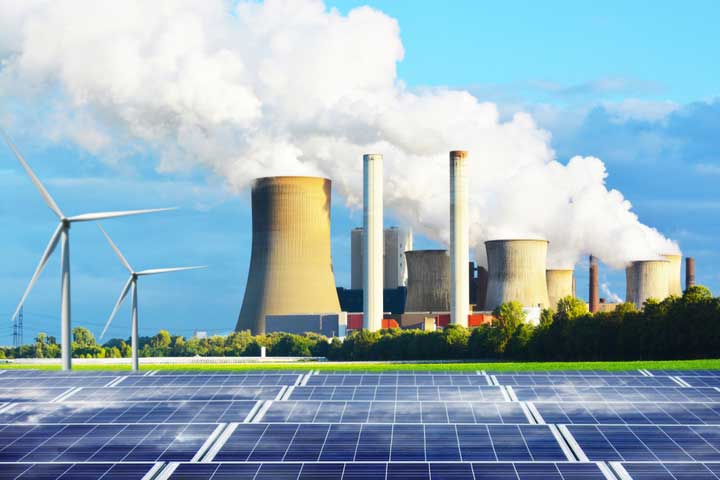
Current Global Status
Coal remains the world’s largest single source of electricity, generating approximately 35% of global power. However, its share has steadily declined from nearly 40% a decade ago. Asia dominates consumption—China, India, and Southeast Asia account for nearly 80% of current coal use. Meanwhile, Europe and North America have reduced coal power generation by over 50% since 2010, with many countries committing to complete phase-outs.
How Coal Plants Operate
Coal-fired power plants burn pulverized coal in a boiler to produce high-pressure steam. This steam spins turbines connected to generators, creating electricity. The steam is then cooled and condensed back to water in cooling towers or water bodies. Modern plants use “supercritical” technology, operating at higher temperatures and pressures to achieve 40–45% efficiency, compared to 33% for older subcritical plants.
Environmental Impact
Coal is the most carbon-intensive energy source, emitting roughly 820–1,050 grams of CO₂ per kilowatt-hour—about double that of natural gas. It also releases sulfur dioxide (causing acid rain), nitrogen oxides (smog), and particulate matter (respiratory illness). Coal ash, a byproduct containing heavy metals like mercury and arsenic, requires careful disposal to prevent groundwater contamination.
Economic Factors
Once considered cheap and abundant, coal now faces economic pressure. In many regions, new wind and solar projects are cheaper than building and operating coal plants. Carbon pricing mechanisms in 70+ jurisdictions add costs—the EU carbon price has exceeded €90 per ton. Many financial institutions now restrict coal financing, increasing capital costs for new projects.
To remain viable, the industry is pursuing efficiency improvements. Ultra-supercritical plants reach 45% efficiency, reducing emissions per unit of electricity. Some plants co-fire with biomass (like wood pellets) to lower carbon footprints. Carbon Capture and Storage (CCS) could theoretically capture 90% of emissions, but high costs and energy penalties (20–30% of plant output) limit deployment to a handful of demonstration projects globally.
Grid Stability Role
Coal provides “baseload” power—continuous, predictable electricity—which has historically stabilized grids. However, with renewable energy expanding, some coal plants are being retrofitted for “load following,” ramping up or down to balance intermittent solar and wind. This cycling increases wear and tear and reduces efficiency, creating operational challenges for plant operators.
Regional Divergence
Developed economies are rapidly retiring coal—the UK reduced coal power from 40% to under 2% in a decade. Meanwhile, emerging economies continue building new capacity. China permitted 114 gigawatts of new coal plants in 2022–2023 (equivalent to Japan’s entire fleet), primarily for energy security and grid stability as renewables expand. India plans incremental additions through 2030 while accelerating renewables.
Social Dimensions
Coal supports approximately 8.4 million jobs globally in mining, transport, and power generation. Phasing out coal requires “just transition” programs, including retraining, pension protections, and regional economic diversification. Germany’s €40 billion transition package for coal regions and South Africa’s $8.5 billion Just Energy Transition Partnership represents models for managing this shift.
Future Projections
The International Energy Agency projects coal demand will peak by 2025 and decline thereafter. In developed nations, unabated coal (without CCS) will likely disappear by 2035–2040. Developing nations may continue using coal longer, particularly if CCS becomes commercially viable. The pace of decline will depend on renewable deployment speed, battery cost reductions, and policy frameworks like the EU’s Carbon Border Adjustment Mechanism.
Alternative Pathways
Some experts propose “coal-to-clean” transitions where existing infrastructure is repurposed. Retrofitting coal plants to burn green ammonia or hydrogen could preserve jobs and grid assets. Converting mines to pumped hydro storage or solar farms offers additional transition pathways. These approaches remain experimental but could provide politically palatable transition options.
Conclusion
Coal power generation is entering an era of managed decline in most markets. Its future will be shaped by climate commitments, technological innovation in both clean energy and emissions reduction, and successful implementation of just transitions for affected communities. The next decade will determine whether coal fades rapidly or persists as a diminishing but strategically maintained resource in the global energy mix.