

Planning for succession is a crucial step in ensuring that corporate activities continue. Important roles can be filled quickly by spotting and developing future leaders.
Everything you need to know to ensure that important responsibilities are filled with the least amount of fuss is covered in this beginner’s guide to succession planning.
What is succession planning?
The process of finding and preparing current staff members to take over leadership positions when they become available is known as succession planning. Employees with leadership potential are trained as part of the process to ensure they are capable of taking over leadership roles when the time comes. It is a crucial administrative process that guarantees seamless organizational operations even in the event that important leadership positions change.
The reason for succession planning
Succession planning is a vital process for identifying and developing potential future leaders within your organization. Yet many businesses fail to properly implement this process, missing out on potential new leaders from their workforce. Succession planning accomplishes a variety of objectives that help leaders reach their full potential while driving a series of benefits for the company at large. While succession planning is most often associated with developing future leaders and senior managers, it can be applied to any role within the company.
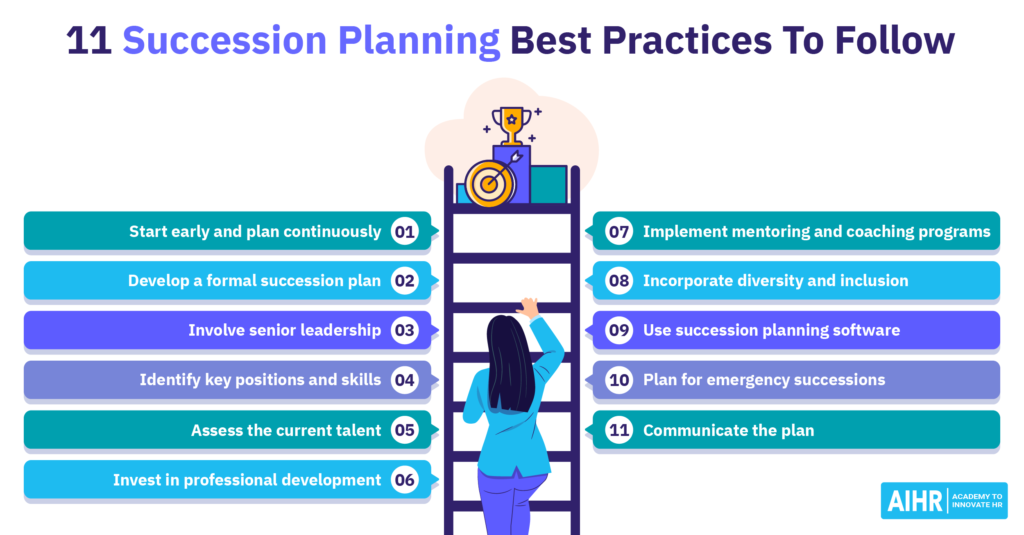
Effective succession planning’s advantages
lowering the possibility of losing seasoned workers who have knowledge and experience essential to the operation of the business.
minimizing disturbance and preserving company continuity by promptly hiring candidates who are accustomed to the organization’s framework.
increasing employee retention and providing a clear career path that values leadership potential.
highlighting the significance of developing leadership across the organization and identifying the locations of the most skilled workers.
lowering recruitment expenses, streamlining the onboarding process, and saving time and money when searching for outside applicants to fill a position.
encouraging staff members to concentrate on their professional and personal growth and to develop a broad range of abilities.
Different methods for succession planning
A people-centric strategy combined with data-driven insights is necessary for effective succession planning. A comprehensive strategy for employee career development should be coupled with an impartial and objective identification process. In order to develop their potential and abilities, emerging leaders should be identified early on.
According to Deloitte’s analysis, succession planning can be approached in four ways:
competitive. Employees are divided into “haves” and “have nots” under this process-based component of succession planning. It provides a foundation for objective decision-making.
In compliance. Compliance, another process-focused component of succession planning, is an annual “check-the-box” exercise.
centered. The centered approach, on the other hand, is sympathetic and captivating while comprehending the main behavioral elements at play.
cozy. This method incorporates decision-making based on trust into the succession planning procedure.
What Kinds of Succession Planning Are There?
Senior leadership roles are the main focus of succession planning. These are the crucial roles that are necessary for the organization to function smoothly at the highest level.
Establishing successors for positions essential to the organization’s performance is one aspect of non-leadership succession planning. This can include positions requiring a high level of technical expertise as well as other specialized positions.
What Constitutes Succession Planning’s Essential Components?
Successful succession planning requires a number of key steps. These include:
1. Taking a proactive position
2. Understanding the requirements of the role in detail
3. Identifying potential candidates
Giving the training and resources needed to bring them up to speed
4. Performing trial runs and shadowing of potential candidates
Integrating succession planning into the company’s recruitment
Why Does HR Need Succession Planning?
Generally speaking, HR departments are more aware of the organization’s advantages and disadvantages. They are therefore ideally suited to assist in overseeing effective succession planning.
They can shortlist possible leadership candidates by mapping out appropriate experience and skill sets using their internal records. In order to guarantee that the finest applicants are chosen, regardless of their position within the organization, they can also assist with cross-departmental succession planning.