
Strong AI, often known as Artificial General Intelligence (AGI), is a sophisticated idea in the field of artificial intelligence. It refers to a machine’s ability to accomplish any intellectual work that a human can complete. This includes abstract reasoning, making complex decisions, comprehending emotional context, and even developing novel ideas.
Unlike today’s AI systems, which are often task-specific and work within preset restrictions, strong AI would have general-purpose cognitive abilities. These capabilities would not be restricted to a single domain or purpose but would adapt and apply to a wide range of novel challenges and environments.
1. What is strong artificial intelligence?
Strong AI, often known as Artificial General Intelligence (AGI), refers to AI systems with general cognitive capabilities. These systems, like humans, can understand, learn, and apply information to a variety of jobs. Strong AI is still a theoretical idea and has not yet been implemented.
2. Characteristics of Strong AI.
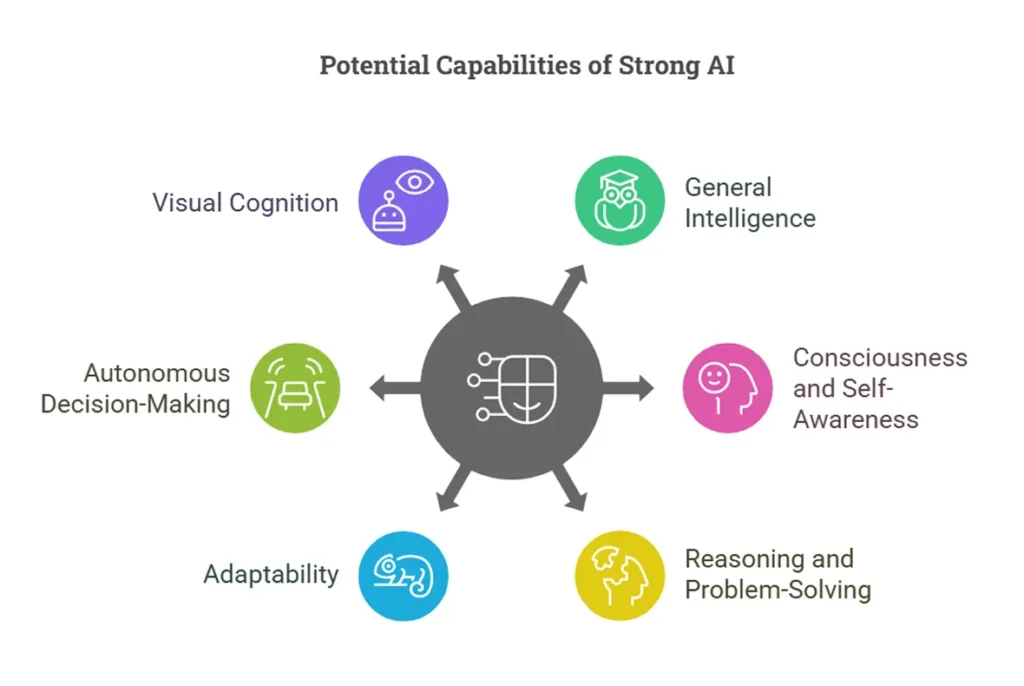
General Intelligence: Strong AI can absorb, learn, and apply information in a variety of circumstances, just like humans.
Consciousness and Self-Awareness: It is self-aware and conscious, which allows it to comprehend and reflect on its existence.
Autonomy: A strong AI can function independently, make decisions, and solve issues without human interference.
Adaptability is the ability to adapt to new settings and learn from experiences in a way that is similar to human cognitive processes.
3. Theoretical implications of strong AI
Human-Like Understanding: Strong AI would grasp natural language, emotions, and complicated concepts at the same level as humans.
Versatility: It can execute a wide range of tasks across multiple areas without being restricted to a certain role.
Ethical and Moral Reasoning: Possess the ability to make ethical and moral decisions while considering the consequences of their acts.

4. Why Strong AI Matters
Strong AI is important because it offers the possibility of robots reasoning, learning, and making judgments with the same depth and flexibility as a human mind. Its progress could result in breakthroughs in science, health, and industry by automating jobs that involve abstract thinking, creativity, and judgment.
At the same time, strong AI raises important philosophical, ethical, and sociological issues:
Control and Safety: How can we assure that machines with general intelligence act in accordance with human values?
Rights and Personhood: If an artificial intelligence becomes self-aware, does it deserve rights or legal status?
Impact on Labor: Could machines replace cognitive employment in a variety of industries?
5. Strong AI in public discourse.
Science fiction, media narratives, and speculative journalism frequently use strong AI to spark public debate. Films such as Her, Ex Machina, and 2001: A Space Odyssey have influenced public perception of intelligent machines that can feel, think, and even confront their creators.
This popular representation has produced a disconnect between expectations and reality. While modern AI excels at tasks like translation and pattern recognition, it lacks consciousness and comprehension. Nonetheless, media coverage can obscure the distinction between real technologies and imagined possibilities, frequently fueling hype or terror.
Public debate raises worries about:
Autonomy and control: Who determines how intelligent systems function and evolve?
Social Impact: What happens when machines replicate or outperform humans?
Trust and Transparency: How can we create systems that people can trust and understand?